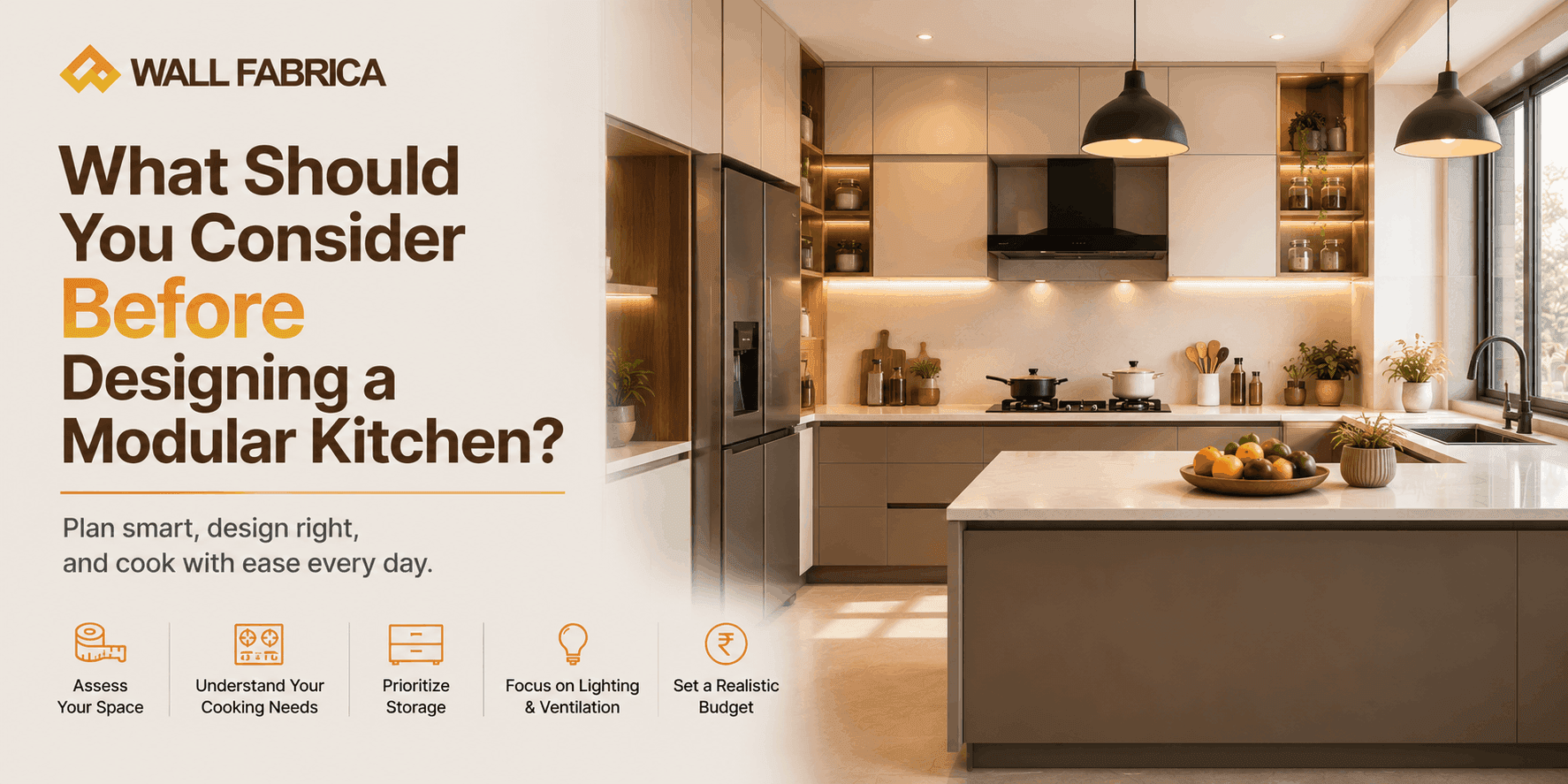
Designing a modular kitchen is exciting.
You start imagining beautiful cabinets.
Elegant countertops.
Modern appliances.
The perfect lighting.
It's easy to get caught up in how the finished kitchen will look.
But here's something many homeowners only realize after they start using it.
A beautiful kitchen isn't always a practical one.
The decisions you make before the design begins often determine whether your kitchen feels effortless to use or frustrating to live with.
At Wallfabrica, we've found that the most successful modular kitchens don't begin with choosing colors or materials.
They begin with understanding how the family lives.
Scrolling through beautiful kitchen photos can be inspiring.
But remember—those kitchens belong to someone else.
Your family has its own routines.
Ask yourself:
These answers should influence the design far more than social media trends.
The best kitchen is the one that fits your lifestyle.
Cooking is a series of small movements.
You collect ingredients.
Wash vegetables.
Prepare meals.
Cook.
Serve.
Clean.
A kitchen should support that natural sequence instead of interrupting it.
If you constantly have to walk across the room or reach awkwardly for everyday items, even simple meals become more tiring than they need to be.
Good design makes movement feel almost effortless.
One of the biggest planning mistakes homeowners make is asking:
"How many cabinets can we fit?"
A better question is:
"What exactly do we need to store?"
Make a list.
Consider items like:
Planning storage around your belongings creates a kitchen that feels organised from the very beginning.
Countertops are where the real work happens.
Vegetables are chopped.
Ingredients are mixed.
Meals are assembled.
Yet many kitchens sacrifice usable workspace in favour of adding more cabinets or appliances.
Think about how much preparation space your family typically needs.
An uninterrupted countertop often proves more valuable than an extra cabinet.
There isn't a single "best" modular kitchen layout.
Different homes require different solutions.
Some common options include:
Homes in Bangalore apartments often need layouts that maximise every square foot, while larger homes in Jharkhand may offer greater flexibility. The right choice depends on your available space and the way your family uses it—not simply on what is currently popular.
Cooking generates:
Without proper ventilation, these can gradually affect both comfort and the condition of your kitchen.
Planning for windows, chimneys, and airflow early in the design process helps maintain a fresher and more enjoyable cooking environment.
Ventilation isn't one of the most visible design decisions.
But it quickly becomes one of the most appreciated.
Lighting can completely change the experience of using a kitchen.
Many homeowners think only about decorative ceiling lights.
Functional lighting deserves equal attention.
Work areas such as countertops, sinks, and cooking zones should be well illuminated.
Good lighting makes everyday tasks:
A combination of ambient, task, and accent lighting usually creates the most balanced result.
Your kitchen should be able to adapt as life changes.
Think ahead.
Will your family grow?
Could your cooking habits evolve?
Might you purchase additional appliances?
Designing with some flexibility can prevent expensive modifications later.
Future-proofing doesn't necessarily require more space.
It requires thoughtful planning.
Beautiful finishes certainly matter.
But ask yourself another question.
Will they suit your lifestyle?
For example:
Choosing materials that align with your daily routine often leads to greater long-term satisfaction.
Every project has a budget.
The goal isn't necessarily to spend more.
It's to spend wisely.
Investing in elements that improve everyday functionality often delivers greater value than spending heavily on decorative upgrades.
A kitchen you enjoy using every day will always outperform one that simply looks impressive.
Design software can produce beautiful layouts.
But great modular kitchens require something more.
An understanding of human behaviour.
Experienced designers ask questions that homeowners sometimes overlook.
How do you cook?
Who uses the kitchen?
Where should daily essentials be stored?
What causes frustration in your current kitchen?
These insights help create spaces that genuinely improve everyday life.
A modular kitchen is one of the most frequently used spaces in any home.
That's why every planning decision matters.
Instead of beginning with colours, finishes, or trends, begin with your family's routines, habits, and practical needs.
When movement, storage, lighting, ventilation, and functionality are carefully considered, the result is a kitchen that not only looks beautiful but also feels comfortable to use every single day.
Thoughtful planning today can create years of convenience tomorrow.
Over the years, we've learned that the happiest homeowners aren't always the ones with the largest kitchens or the most premium finishes. They're the ones whose kitchens quietly support their everyday routines without creating unnecessary effort.
At Wallfabrica, we believe every modular kitchen should be designed around the people who use it. By understanding your lifestyle, cooking habits, and future needs, we create spaces that combine functionality, comfort, and timeless design to make everyday living easier.