
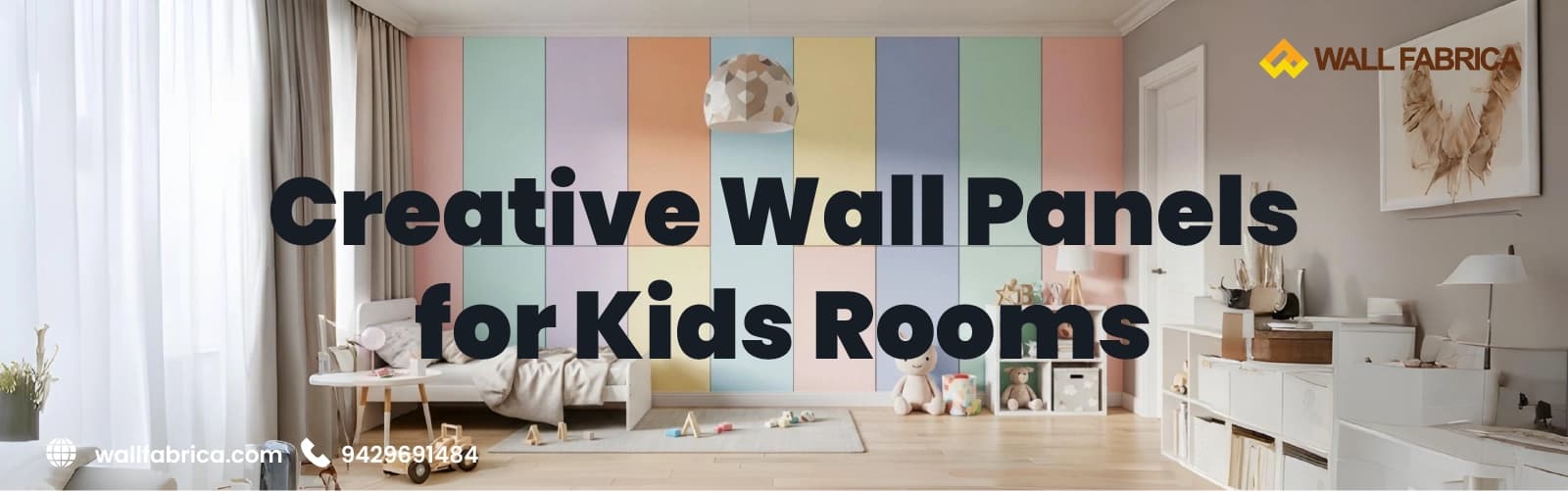
Every parent who walks into our studio says some version of the same thing: "I want it colourful and fun, but I don't want to be scrubbing crayon off the wall every week."
That's really the whole brief for a kids' room. It has to be a space for play, a space for learning, and somewhere a child genuinely feels settled — and it has to survive daily wear without turning into a chore for you. Wall panels solve more of this than people expect. Here's how I'd break it down if you were sitting across from me right now.

Before we even get to themes, let's talk about why panels beat plain paint for a child's room specifically.
Once parents hear this, the theme conversation becomes the fun part, not the anxious one.
A toddler's room shouldn't be visually loud. Softer tones help them settle, especially around nap and bedtime.
These shades are gentle on the eyes and, practically speaking, they work for either a boy or a girl — useful if you're not decorating a nursery from scratch a second time.
This is the age where characters and stories matter. But you don't need the whole room to look like a cartoon set.
One themed wall reads as playful. Four themed walls reads as overwhelming, for you and for them.
Not every child wants cartoons. Nature textures tend to hold interest longer and age more gracefully.
Pair this with warm lighting instead of harsh white light — it changes how the whole room feels once evening comes.
Once a child starts school, the wall can start pulling double duty.
Panels give you a flat, even surface to mount these on properly, instead of tape marks and pin holes straight into the plaster.
If two kids are sharing one room — common in many Bokaro and Ranchi homes where space is tighter — two-tone panelling helps define zones without a physical partition.
One tone for the sleeping side, another for the play side. It's a small visual cue, but it genuinely helps a shared room feel organised.
Teenagers want their room to feel less "childish," and that usually means fewer patterns, not more.
A minimal base like this ages well — it won't look out of place when your child is twelve instead of five.
| Child's Age | Suggested Panel Theme |
|---|---|
| Toddler | Soft pastel tones |
| Preschool | Cartoon or nature accent wall |
| School-age | Learning-focused wall |
| Teen | Minimal, muted textures |
| Shared room | Two-tone division |
Here's something parents rarely think about until it's a problem: a kids' room takes more physical abuse than any other room in the house — climbing, pulling, leaning near the bed, toys thrown at the wall. That makes fitting quality more important here, not less. We've laid out exactly why in our guide on why choose professional installation, and it's worth reading before you lock in a kids' room design.
Good-quality PVC and laminate panels are non-toxic, resist mould, and clean up far more easily than painted walls — a real advantage in a room dealing with spills and sticky hands daily.
Keep the base neutral and minimal, and let one accent wall or swappable decor carry the "theme." You can update that one wall later without redoing the whole room.
Two-tone panelling. It visually separates the space into a sleep zone and a play zone without needing an actual wall or partition.
A good kids' room isn't about how loud the theme is — it's about how well it supports play, rest, and learning without becoming extra work for you. Pick something that can grow with your child, keep the palette calm, and let one wall carry the personality.
If you're planning this for a home in Bangalore, Ranchi, or Bokaro, this is the kind of detail-first thinking Wallfabrica brings to every kids' room project — from choosing the theme to making sure it's fitted to actually last.