
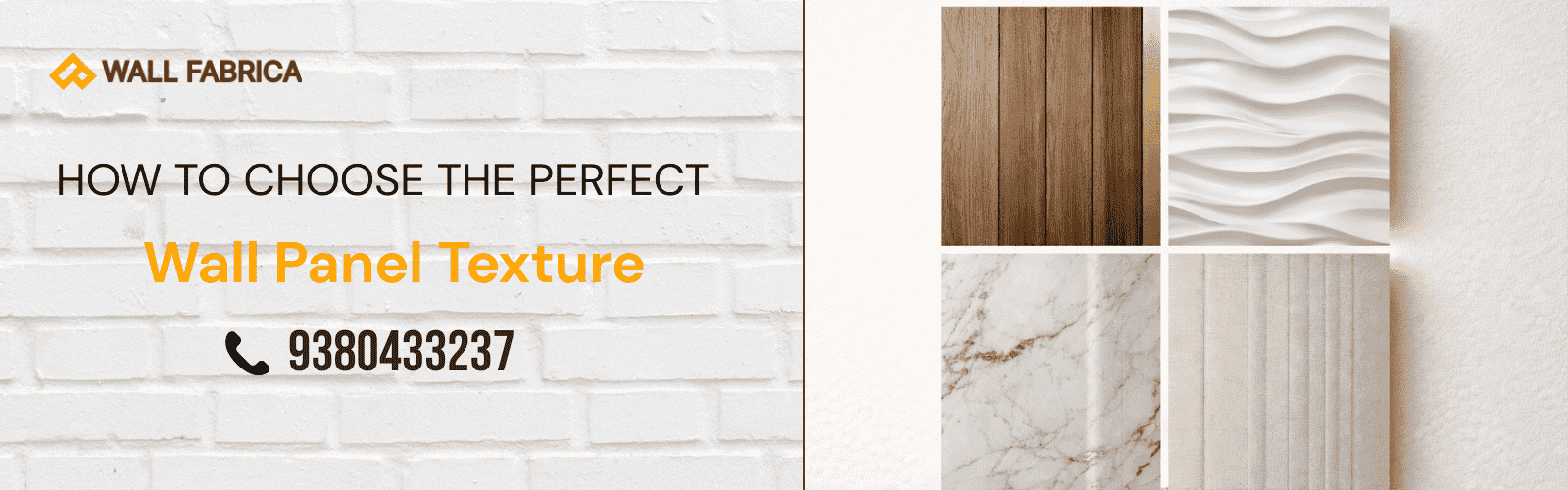
When people choose wall panels, colour usually gets the first conversation. Texture often comes later. But texture can quietly change how a room feels, how much depth it appears to have, and how well the walls work with lighting, furniture and other finishes.
As ArchDaily’s discussion of texture, warmth and ceiling systems explains, elements such as light, proportion, texture, colour and materiality all influence how people perceive an interior, including its depth, scale and atmosphere.
That is why choosing a wall panel texture should not simply be about picking the pattern that looks attractive in a catalogue. The better question is: Will this texture work in my actual room?
Here is a practical way to decide.
The right texture depends heavily on what happens inside the room.
Before selecting a panel, ask:
For example:
The purpose of the room should come before the trend.
The same wall panel can look completely different under different lighting conditions.
Natural daylight, warm ceiling lights and cool white LEDs can change how colours and textures appear.
Sherwin-Williams’ guide to choosing paint colours also points out that colour can change depending on the light source and time of day, which is why finishes should ideally be assessed in the actual space.
Before finalising a panel:
This is particularly important with 3D panels, grooves and deeply embossed textures because lighting can emphasise every contour.
Texture has a visual weight.
A large room can generally accommodate stronger patterns more comfortably, while a compact room may benefit from something more restrained.
For smaller rooms:
This follows the broader principle that lighter colours can make smaller spaces feel more open, while darker shades can make surfaces feel closer and more intimate, as explained by Sherwin-Williams.
The goal isn't to make a small room look empty. It is to make the visual elements feel proportionate.
Your wall should look like part of the room rather than something added afterward.
Consider:
Consider:
Consider:
The important thing is consistency. If your furniture, flooring and lighting already have strong visual character, the wall texture does not necessarily need to compete with them.
Colour and texture should be considered as a pair.
A dark colour combined with a deep texture can create a dramatic wall. A light neutral colour with a subtle texture can create a softer appearance.
For example:
If you are still deciding on the colour palette, you can also refer to our guide on Best Color Themes for Luxury Interior Designs before finalising the panel texture.
A beautiful texture is not necessarily practical for every part of your home.
Before selecting a panel, consider:
For high-use areas, a finish that looks good while remaining relatively easy to maintain can be more practical than an extremely intricate design.
The best panel is not simply the one that looks impressive on installation day. It should continue to work for you months and years later.
Not every wall needs the same treatment.
A darker wood, marble or stone-inspired texture can create a strong backdrop without requiring additional decoration.
Wood and stone textures can provide warmth and make the dining area feel more intentional.
This is an opportunity for a distinctive texture because it is one of the first areas visitors see.
Choose finishes based on the wall's exposure to moisture, heat, cleaning and everyday use rather than appearance alone.
Moisture resistance and maintenance should take priority alongside appearance. A textured wall should not be selected simply because it resembles a particular stone or finish.
One of the easiest mistakes to make with wall panels is assuming that every wall needs to have the same texture.
It doesn't.
A single feature wall can often create enough visual interest.
You could use:
Then keep the remaining walls relatively simple.
This creates contrast and allows the textured surface to become a deliberate design element rather than visual background noise.
A texture can look impressive online but feel very different when you live with it every day.
This becomes particularly important if you may eventually rent or sell the property.
Research from the National Association of Realtors' 2025 Profile of Home Staging found that 83% of buyers' agents said staging made it easier for buyers to visualise a property as their future home.
That doesn't mean a particular wall texture will increase your home's value. It does highlight the importance of presentation and how a space is perceived.
When choosing a panel, therefore:
If you are planning a broader renovation rather than changing only one wall, our Interior Makeover Checklist for Homeowners can help you think through the different elements before starting the makeover.
If you are standing in front of several samples and cannot decide, use this simple sequence:
Room purpose → Lighting → Room size → Interior style → Colour → Maintenance → Wall location → Long-term appeal
If a texture works across all eight, it is likely to be a more considered choice than one selected purely because it looks attractive in a photograph.
The perfect wall panel texture is not necessarily the most expensive, dramatic or fashionable one.
It is the one that fits the way you actually use your room.
A good texture should work with your lighting, complement your furniture, suit the room's proportions and remain practical enough for everyday life. In a compact home in Bangalore, a subtle textured feature wall may work better than covering every surface with a heavy pattern. Similarly, in homes across Ranchi, Bokaro or Dhanbad, the right wood, stone or neutral finish can add character while still fitting comfortably into the overall interior.
At Wallfabrica, the objective should not simply be to put a panel on a wall. It should be to help the wall become part of a complete interior.
Because when the texture, colour, lighting and furniture all work together, the wall stops looking like an isolated design choice—and starts feeling like it belongs there.